
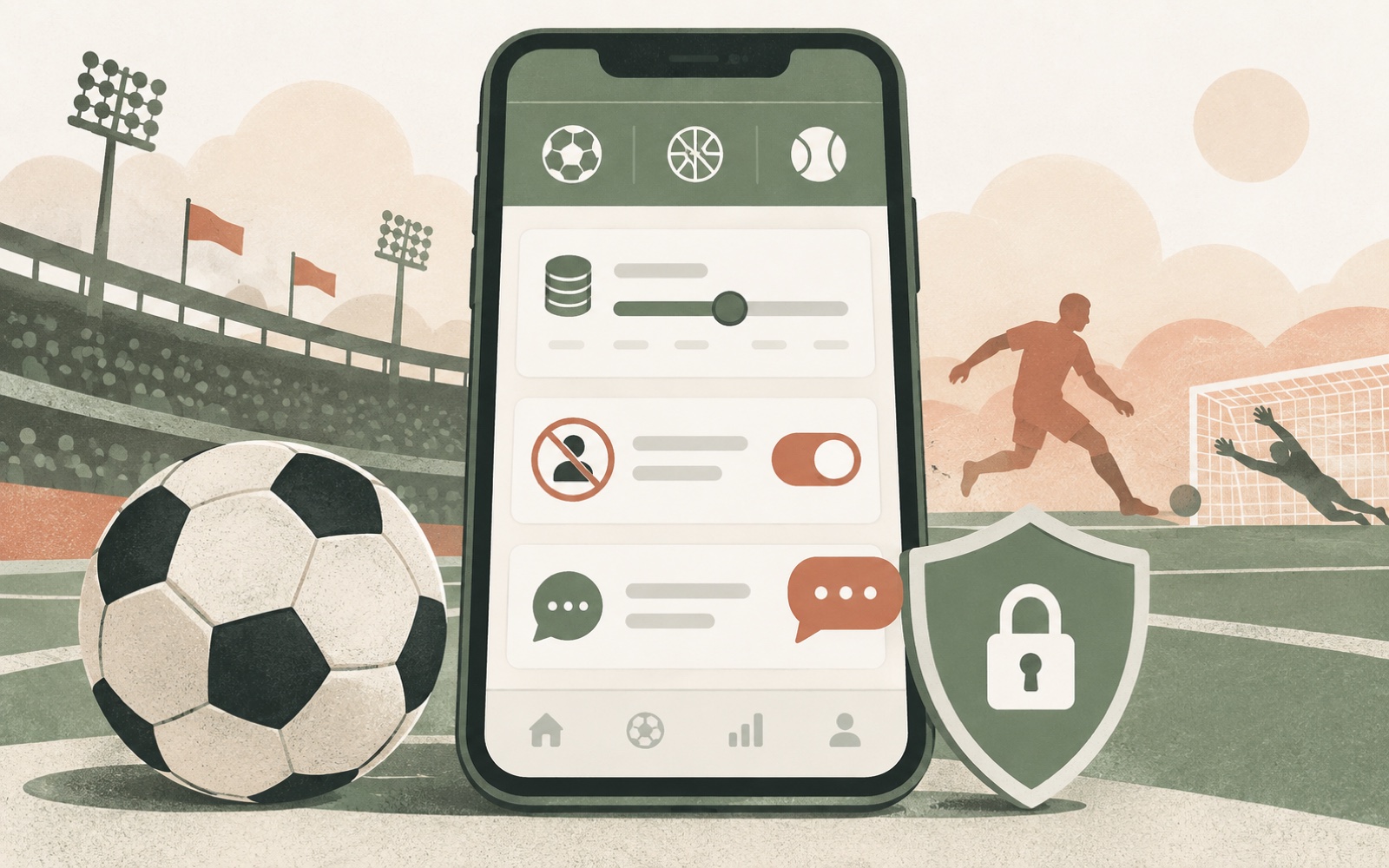
An app is not a different bookmaker from the website. It is the same UK licensed operator in a more convenient wrapper, which cuts both ways. The convenience that lets you check a limit in two taps is the same convenience that puts a live market in your pocket every waking hour. A good app tips that balance towards control; a poor one tips it towards spending.
This guide looks at what to expect from an app versus the mobile site, the safer-gambling controls you have a right to find quickly, how to keep your account secure, and, when something does go wrong, the exact ladder of complaint from the operator's own team up to an approved dispute resolver. Knowing that ladder before you need it is what turns a frustrating problem into a solvable one.
01
Betting apps compared with the mobile site
The first thing to settle is that an app gives you no different legal protection from the mobile website. Both are operated under the same UK Gambling Commission licence, both must offer the same safer-gambling tools, and both are bound by the same terms. So the choice between them is practical, not a matter of safety. An app can be faster, works better offline for browsing, and can use your phone's own security, while the mobile site needs no download, takes no storage and is easy to walk away from because it is not sitting on your home screen.
For many people the mobile site is the calmer option precisely because it adds a little friction. If you find that having an app makes you open it out of habit, that is useful self-knowledge. Whichever you use, the test is the same. Can you find the licence details, the limits and the help contacts without hunting, and does the operator appear on the Commission's public register. If those check out, pick the format that helps you bet less often, not more.
02
What a good app lets you control
The mark of a well-made app is not flashy live streaming; it is how quickly you can take control of your own account. Deposit limits should be reachable in a tap or two and should apply the moment you tighten them, while any request to raise a limit is held for a cooling-off period before it takes effect. That asymmetry is deliberate, and an app that reverses it, making increases instant and decreases slow, is one to distrust.
Look also for time-outs, a short self-imposed lockout of a day, a week or longer, reality checks that interrupt a long session with a reminder of time and money spent, and clear in-app access to self-exclusion. These are not optional extras. A UK-licensed operator must provide them, and a good app surfaces them rather than burying them three menus deep.
A common example
Picture setting a £50 monthly deposit limit on a Sunday evening. On a well-designed app the new, lower limit is live at once, and if you later try to raise it the change is queued for a day or two rather than applied on the spot. That single design choice, an instant decrease and a delayed increase, does more to protect a wobbling moment than any warning message. If you want a total break rather than a limit, self-exclusion in the app and a GAMSTOP registration go further, as the next section explains.
03
Security, logins and staying safe on mobile
Because an app holds your money and your identity, basic account security matters as much as the betting controls. Use a strong, unique password that you do not reuse on any other site, and turn on two-factor authentication, or 2FA, where the operator offers it, so that a stolen password alone cannot open your account. Many apps also support a fingerprint or face login, which is convenient and keeps a casual snooper out, though it is not a substitute for a proper password behind it.
Keep the app updated, download it only from the official app store rather than a link someone sends you, and be wary of any message asking you to confirm login details, as a legitimate operator will not ask for your password by email or text. If you want to stop gambling rather than simply secure the account, in-app self-exclusion locks you out of that operator, and a single free registration with GAMSTOP blocks every UK-licensed gambling site and app in one step. Removing the app from your phone afterwards removes the daily prompt to return.
| What to check | Why it matters | Where |
|---|---|---|
| UKGC licence | Same protection on app and mobile site, gives a dispute route | Public register |
| Safer-gambling tools | Limits, time-outs and self-exclusion, ideally a tap away | Account settings |
| Account security | Strong unique password plus 2FA guard your funds | Security settings |
04
Customer support and response times
Good support is easy to reach and honest about timing. Before you deposit, look for how you can contact the operator, live chat, email and ideally a UK phone line, and whether they state expected response times. Live chat should answer within minutes for straightforward questions; email queries commonly take up to a day or two. Vague or hidden contact details are a warning sign, because the point at which you most need support is usually the point at which money is involved.
When you do get in touch, keep it factual and keep records. Note the date and time, save chat transcripts and screenshots, and write down the name of anyone you speak to. Most everyday issues, a withdrawal query, a bonus that did not credit, a market you think was settled wrongly, are cleared up at this stage. Support that is polite but slow is an inconvenience; support that cannot be reached at all is a reason to take your custom elsewhere.
Key points
- An app and the mobile site carry identical legal protection, so choose the format that helps you bet less, and use the limits either way.
- Protect the account with a strong unique password and 2FA, and use in-app self-exclusion or one free GAMSTOP registration for a clean break.
- Complain to the operator first in writing; if unresolved after eight weeks or at deadlock, take it free to an approved ADR provider such as IBAS. See our warning signs guide too.
05
How to make a complaint that gets heard
A complaint that is written, dated and specific gets results; an angry phone call rarely does. Always start with the operator itself, because the rules require you to give them the chance to put things right before anyone else will look at it. Put your complaint in writing through the operator's official complaints channel, not a throwaway chat message, so there is a record.
Set out who you are, the account concerned, exactly what happened with dates and bet references, why you think it is wrong, and what you want done, whether that is a payout, a refund or an explanation. Attach your evidence. Ask for their final response, sometimes called a deadlock letter, if they cannot resolve it, because that document is your key to the next stage.
A common example
Suppose a withdrawal is delayed for a fortnight with no clear reason. You email the operator's complaints address, quote your account and the withdrawal reference, state the date you requested it, and ask for either payment or a written explanation within a set time. If they refuse, stall, or send a final response you disagree with, you have a documented case ready to hand to an alternative dispute resolution provider, which is where the next section picks up.
06
Alternative dispute resolution and IBAS
If the operator's own process does not settle the matter, every UK-licensed operator must give you free access to an approved alternative dispute resolution, or ADR, provider. ADR is an independent service that reviews the evidence from both sides and reaches a decision, at no cost to you, without the need for court. One long-established provider named by many operators is IBAS, the Independent Betting Adjudication Service, and the operator's terms will tell you which provider covers your dispute.
You normally reach ADR once you have the operator's final response, or after eight weeks without resolution. Send the provider the same clear, dated account and evidence you gave the operator. ADR decisions on the facts of a bet are generally binding on the operator, which is what gives the process teeth. It cannot, however, deal with matters outside its remit, such as how quickly a firm chooses to pay in general, so frame your complaint around the specific transaction or term in dispute.
07
When to escalate to the regulator
People often assume the Gambling Commission is where you go to get your money back. It is not. The Commission regulates operators and enforces the rules, but it does not resolve individual disputes or recover funds for customers. That job belongs to the operator first and to an approved ADR provider second. What the Commission does want is your report, because the information it gathers about how firms behave feeds directly into its regulation and enforcement, and can prompt action against an operator that is treating customers unfairly.
So the sensible order is clear. Complain to the operator, escalate to the ADR provider if needed, and separately report poor conduct to the Commission so it can act at the level of the licence. Change is coming too. A statutory Gambling Ombudsman was proposed in the 2023 Gambling Act White Paper to give consumers a single, free and independent route for complaints, and it is being introduced, so the path to redress should get simpler. Until then, keep your records, follow the ladder in order, and remember that a calm, documented case is your strongest asset.
Related reading on this site
- How to choose a betting site in the UK
- How to check a betting site's UKGC licence
- Understanding odds, markets and value
- Deposits, withdrawals and the credit-card ban
- Safer gambling tools and GAMSTOP
- Warning signs of an unsafe betting site
- Bet types, accumulators and cash out
How we check our facts
The complaints steps and ADR position here follow guidance from the Gambling Commission, with support information from GamCare. The Gambling Ombudsman reflects the 2023 White Paper proposal and is described as forthcoming. This page reflects the position in September 2026. Last reviewed 25 September 2026.

Frequently asked questions
Is a betting app safer than using the mobile website
Neither is inherently safer, because both must come from the same UK Gambling Commission licensed operator and offer the same safer-gambling tools and terms. A well-built app can add device-level protection such as a fingerprint or face login and quick access to limits, which is a genuine plus. The trade-off is convenience, since an app sits on your home screen and can make betting feel more constant, so choose whichever helps you stay in control and use the limits either way.
Can I set deposit limits and self-exclude inside the app
Yes. Every UK-licensed operator must let you set deposit limits, take a time-out and begin self-exclusion, and a good app puts these within a couple of taps rather than burying them. Limits should apply instantly when you tighten them, while requests to raise them are subject to a cooling-off delay. For a complete break, one free registration with GAMSTOP blocks every UK-licensed gambling site and app at once, regardless of the operator you signed up with.
How do I make a complaint about a betting operator
Complain to the operator first, in writing, quoting your account details, the dates and any bet references, and keep a copy of everything. Give them a clear description of what went wrong and what you want done. If they do not resolve it within eight weeks, or they issue a final response, or deadlock letter, that you disagree with, you can take the matter free of charge to the operator's approved alternative dispute resolution provider, such as IBAS. A written, factual complaint is far more likely to be settled in your favour than an angry phone call.
Will the Gambling Commission settle my dispute
No. The Gambling Commission regulates operators but does not resolve individual disputes or recover money for customers. It does want to hear about problems, because the reports it receives feed directly into how it regulates and enforces the rules. Individual disputes are handled by an approved alternative dispute resolution provider after the operator's own process. A statutory Gambling Ombudsman was proposed in the 2023 White Paper to give consumers a single free route, and is being introduced, so the routes open to consumers should become simpler in time.